

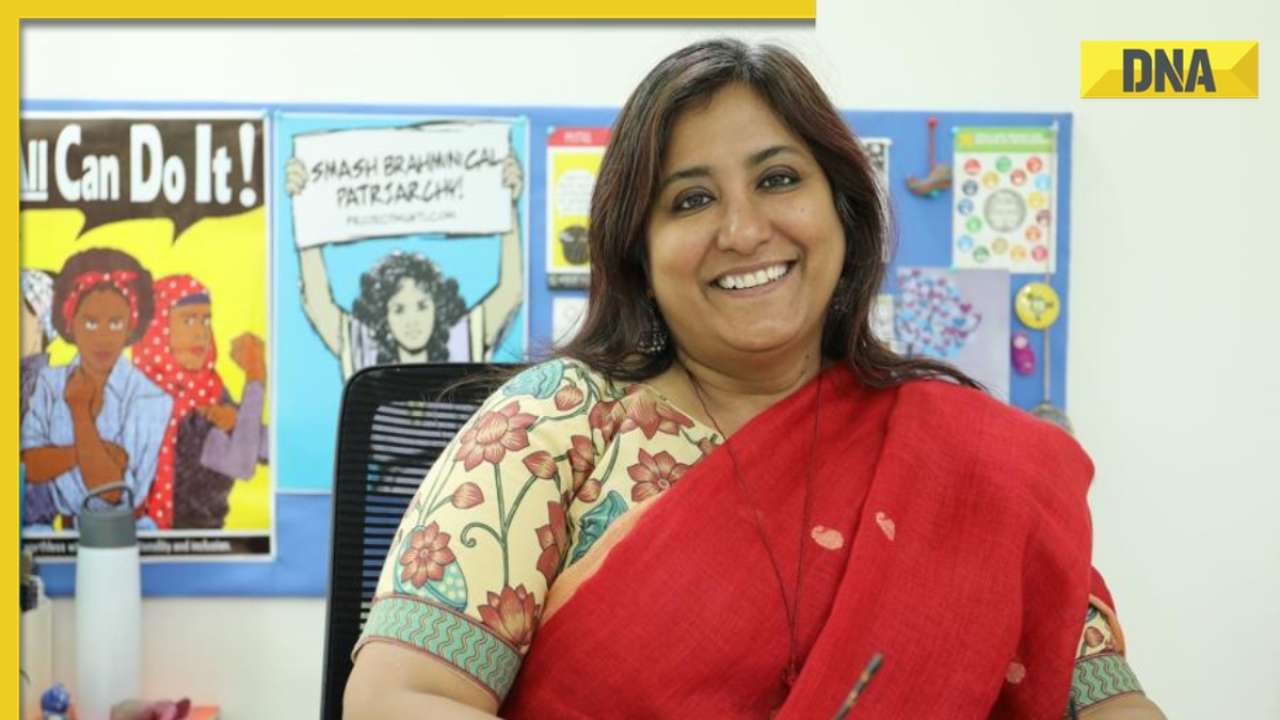
In Conversation with Sohini Bhattacharya, CEO, of Breakthrough, on the 24th Anniversary of Breakthrough.
What are the key moments you’d like to highlight from the last 24 years of Breakthrough?
Breakthrough was launched with the critically acclaimed music video ‘‘Mann ke Manjeeré.’ This was the most exciting moment for all of us. The music video was based on the true life of a woman who was forced to leave her abusive home and become a truck driver. The objective of the music video was to promote women’s rights and bring attention to the issue of domestic violence.
The music video received widespread attention, not only in India but outside the country as well. Traditionally, and even today, the objectification of women in films, television series, and OTT content is considered a prerequisite for commercial success. However, the music video ‘Mann ke Manjeeré’ showed us that this is not quite true. The album received an overwhelmingly positive response from audiences across the globe because of the compelling story that it told. This was one of the turning points in our journey.
In 2008, we launched another campaign called ‘Bell Bajao’, asking men and boys to stand up against domestic violence, through a simple action like ‘Ringing the Bell’. That campaign went viral. And the government of India extended its support to us. As a result, it reached over 243 million people in the country. It was adopted in nine other countries, spanning different languages. The UN general secretary rang the bell and Amitabh Bachchan tweeted about it. It was a pivotal moment and it established us as a campaigning organization. This was in 2008.
But later in 2012, we realized that if we have to change the very deep-rooted gender bias, discrimination, and violence in society, we have to start working with young people. This was when we started working with adolescents in government schools. Then, to assess the impact of the interventions, we did a very rigorous Randomized Controlled Trial with Network (RCTN) based evaluation. The assessment showed significant changes in attitudes and behaviours, for both girls and boys. This again was a critical moment in our journey that kind of determined the course of what was to follow.
Our decision to work with various state governments under education departments marked a significant milestone for us. As a result, we are working with the state governments of Punjab and Odisha to implement a gender-sensitive curriculum program in the government schools. We hope to develop a replicable model from this experience, encouraging other governments to adopt the curriculum.
How did COVID or post-COVID impact the implementation of the gender-based curriculum that you just mentioned?
Before COVID-19, our approach to implementing the gender-based curriculum involved moving from school to school, village to village, and continually expanding our reach to include more and more villages. When the pandemic broke out, we realized that this approach was not very effective with logistical challenges. It would require a lot of time and resources which we don’t have as a non-profit organization.
Hence, we decided to establish a self-sustaining model in which Breakthrough collaborates with the school system, involving teachers, principals, and students, to initiate grassroots transformation, enabling self-driven progress.
When you say ‘system’, do you mean the curriculum of schools?
No, not just the curriculum, but the whole school system. The mindset, within the school system of principals, teachers, administrative officers, the curriculum, and the parental engagement. These are the four legs of the holistic program, which really help in looking at how schools prioritize gender norm change.
This includes how girls are treated within schools, whether girls are being asked questions, whether they need a push for STEM education, and whether they need a push for sports. It doesn’t happen always, right?
Can we build a system where this is being done, over and over again so that even if the kids are not there tomorrow, schools will take this forward? And that’s the idea behind this – a self-sustaining model of positive and lasting change.
Considering your partnerships with the Punjab and Odisha governments, what are your long-term goals? which are the other states and what activities are planned in the next two to three years?
These are the two states where we have been implementing the program now. So, we’ll create a toolkit or a playbook, which we can give to other governments if they are interested in adopting the curriculum program in their respective states.
We’re getting calls from other governments like the Rajasthan government and Delhi government. But we don’t want to spread ourselves too thin, as we have limited resources. We can implement the process in these two states, share the results with other people in other states, and say, go ahead and do this. We can be technical advisors in doing this in any other state of India.
Even outside India where gender transformative school education is not a reality yet. There are many countries, even countries such as the US, UK and other places, where it’s very developed, this is not a norm.
What are the differences in terms of your learnings, you found in Punjab and Odisha?
Our experience in Punjab taught us that co-creation with the government is essential. It’s not enough to simply present them with a curriculum and expect it to be scaled up. You have to listen to the government, work with the government and you have to take the government as an ally. This kind of partnership can lead to significant positive outcomes.
Secondly, teachers are pivotal to the success of this program. If you can change your teacher’s behaviour in India and inspire them to bring gender-equitable behaviour into the classroom, your job is done. The teachers are key. You have to talk to teachers; you have to create products for teachers that they can link to the class. Because the teachers have so many things to do.
This approach becomes more holistic, focusing on the whole system rather than individual components, and one must be ready for it. The support from the government in Punjab and Odisha is highly commendable. For instance, this year, the Punjab government has incorporated the changes we suggested into the printed textbooks, which is a significant achievement.
How violence against women, especially in the states that you have mentioned that you work in, is increasing. What type of perceptions you’ve helped change or build, in the time that you’ve been doing this?
One of the things we’ve achieved is a shift in the perception of violence against women and girls. For many, it has transformed from being viewed as a personal matter into something that many upstanding individuals, both boys and girls, feel empowered to stand against and say no to.
Our programs have led to positive changes, encouraging boys to recognize that sharing domestic chores should be the norm. Additionally, we’ve empowered parents to stand up and support girls who express their desire to pursue education instead of early marriage.
I went to Uttar Pradesh, just last week, where we found a village Pradhan who supports all the young people. They’ve brought solar power to their school. There was no electricity in the school. They have built a concrete road in front of the school. Now, they’re campaigning for a high-secondary school in the region. These are some of the changes that we see, that happen, because of our interventions and collective efforts.